
Choosing a university degree is one of the biggest decisions you will ever make. In many ways, you are choosing your future.
What will you study? What kind of career will it lead to? Will you work close to home or halfway around the world? What happens if the career you want at 17 turns out not to be the career you want at 25?
A hospitality management degree gives you more room to explore than you might expect.
Hospitality is a global business spanning hotels, luxury, travel, events, restaurants, wellness, real estate and more. Within those industries are careers in operations, marketing, finance, sales, human resources, entrepreneurship and leadership.
In other words, choosing hospitality management does not mean choosing one job. This degree path opens the door to dozens of exciting and well-paid careers.


What Do You Actually Study in Hospitality Management?
A degree or major in “Hospitality Management” is much broader than learning how to run a hotel.
Hospitality management degrees combine the major topics covered in a business degree with extra focus on the expertise relevant to the service and experience industries. Because hospitality and travel are such global industries, you also spend significant time learning about the specifics of international business and global markets.
Depending on the university you choose, students earning a hospitality management degree may study areas such as:
- Business Management
- Finance
- Marketing
- Revenue Management
- Operations
- Leadership
- စွန့်ဦးတီထွင်မှု
- Human Resources
- Customer Experience
- Events
- Technology and Innovation

At AIHM
students in the Bachelor of Business Administration in Global Hospitality Management move between academic study and practical experience. The programme is taught by AIHM in academic association with Switzerland’s Les Roches and includes two internship semesters.
Understanding hospitality means understanding both the business decisions happening behind the scenes and the experiences being delivered in front of the customer.
As Chris Meylan, COO of Minor Education, explains
Hospitality management education is not about training students for one operational job:
“We don’t just train you to be a chef or a housekeeper; we train you to understand their challenges so you can lead these teams later.”
While front-line operational roles are extremely important, a hospitality management degree focuses, as the name indicates, on management. Rather than simply learning how to work in hospitality, develop the knowledge and perspective to manage, innovate and lead within it.

Hotels Are Only the Beginning
Hotels are an obvious destination for hospitality graduates, but they are far from the only one.
Even a single international hotel contains a surprisingly wide range of careers. Behind the lobby are departments dedicated to finance, sales, marketing, public relations, revenue management, events, F&B, human resources, digital systems, guest experience and operations.
Zoom out beyond hotels and the possibilities grow further.
Hospitality graduates can build careers in areas such as:
- Luxury Brands
- Events and Entertainment
- Airlines and Aviation
- Cruise Lines
- Travel and Tourism
- Restaurants and F&B
- Health and Wellness
- Real Estate
- Marketing and E-commerce
- Technology
- Financial Services
- စွန့်ဦးတီထွင်မှု
These careers may look very different, but they draw on many of the same skills: understanding customers, managing operations, leading people, and creating experiences. For a student choosing a degree, having many possible career paths can be a major advantage. Your first career decision does not have to become your last one.
Build a Career That Can Cross Borders
Hospitality is also one of the most international businesses in the world.
Major hotel groups operate across dozens of countries. Luxury and travel brands serve global markets. Teams frequently bring together people from different nationalities, languages and cultures.
For students who want an international career, a hospitality management degree offers opportunities at several stages.
You might complete an internship overseas. Maybe, you begin your career in Bangkok and later transfer to another country. You could join a global brand and build experiences across different markets. Even if you work for an individual hotel property or a regional office, your professional network often stretches far beyond the country where you are based. You may be catering to guests from multiple international markets and collaborating constantly with partners abroad or travelling to meet with them.
AIHM lecturer
Gilles Charlet knows how far a hospitality career can travel. Over four decades, his work has taken him across Asia, Europe, the Middle East and Australia, including cities such as Shanghai, Dubai, Geneva, Danang, Montreux, Macau, Zurich, Cairo, Jakarta, Singapore, Sydney, Brighton, Munich, Berlin and Bangkok.
“From a young age, I was drawn to the idea of travelling the world, exploring different cultures and meeting people from all walks of life,” he said. “Hospitality offered me a unique path to do all of that while developing a meaningful career.”


Hospitality Management or Business Degree?
For many students considering hospitality management, this is the real question.
You’re interested in business. You want strong career prospects. And a career in global hospitality sounds exciting.
Why specialise in hospitality rather than simply studying business? It’s important to understand: these two degrees are not opposites, or mutually exclusive fields.
A hospitality management degree is a business degree applied to a particular kind of business environment. Students encounter finance, marketing, strategy, operations, leadership
and entrepreneurship—and apply them within an industry where customers, employees and business performance interact constantly.
In a hospitality management degree
you study business principles, often with a strong additional practical focus applied to service and experience industries. When learning business principles, you also explore the question: How does this work in the real world?
How do you manage a team when customers are waiting?
How do pricing decisions affect revenue?
How do you market an experience people cannot try before they buy?
How do you maintain quality across hundreds of daily interactions?
How do you turn an impressive concept into a profitable operation?
For students who enjoy business but also want an education grounded in people, places and experiences, hospitality management offers a distinctive route.
Some students or their parents can wonder if a hospitality mangement degree is too limiting. Because so many of the skills are transferable, specialising does not necessarily mean narrowing your future to hospitality. The same commercial, leadership and people-management skills travel smoothly into numerous other industries.
The Skills That Travel with You
The industries and jobs you encounter during your career may change. Transferable skills give you the ability to change with them.
Hospitality management develops capabilities such as:
Leadership
Hospitality businesses depend on teams. Learning how departments work together creates a foundation for managing people and organisations later.
Business Thinking
Revenue, costs, profitability, marketing and growth are just as essential in hospitality as they are in any other commercial sector.
Communication
Hospitality professionals constantly communicate: with customers, colleagues, senior managers, suppliers, media contacts and business partners.
Problem-solving
Service businesses move quickly. Problems often need to be understood and solved while the operation continues around you.
Cultural Intelligence
International teams and customers require an ability to understand different expectations, behaviours and communication styles.
Customer Experience
Hospitality trains people to think carefully about how customers experience a brand: a skill increasingly important in industries far beyond hotels.
These skills can follow you from property operations to a corporate office, from one company to another, or from hospitality into an entirely different business sector, such as private banking or real estate development.
Property or Corporate? Hospitality Careers Go Both Ways
Even if you stay within the hotel industry, there is more than one professional world to explore.
One is the property side: the hotels and resorts themselves. Careers here can include Front Office, Food & Beverage, Rooms, Events, Sales, Revenue Management and eventually senior operational leadership.
The other is the corporate side: the teams that support and steer entire hotel brands or portfolios. Corporate careers can include Marketing, Finance, People & Culture, Development, Strategy, Digital, Commercial and Learning & Development.
AIHM graduate Sandi Davies has experienced both perspectives: life onsite at properties during her internships and then work in corporate offices immediately after graduation.

After earning her degree from AIHM
Sandi joined Minor Hotels’ Ascent Management Traineeship, gaining exposure to People & Culture, Marketing and Social Media at the corporate level. Her work at Minor has included market research, presentations, candidate analysis and projects supporting hotel properties across a larger international organisation.
A hospitality management degree equips you to pursue both property and corporate careers. As Minor Hotels Vice President of Learning & Development and Talent Management Bree Creaser has told AIHM’s young professionals, “Understanding how hotels work makes you a bigger asset to corporate offices.”
Some people love working on property. You get to spend every day in a luxurious setting that for many individuals is only a once-in-a-lifetime experience. Other people prefer life in the corporate office and roles overseeing an international portfolio. A hospitality management degree equips you for both.
You Don’t Have to Know Your Destination Yet
One of the advantages of a broad, practical degree is that you can discover opportunities as you go.
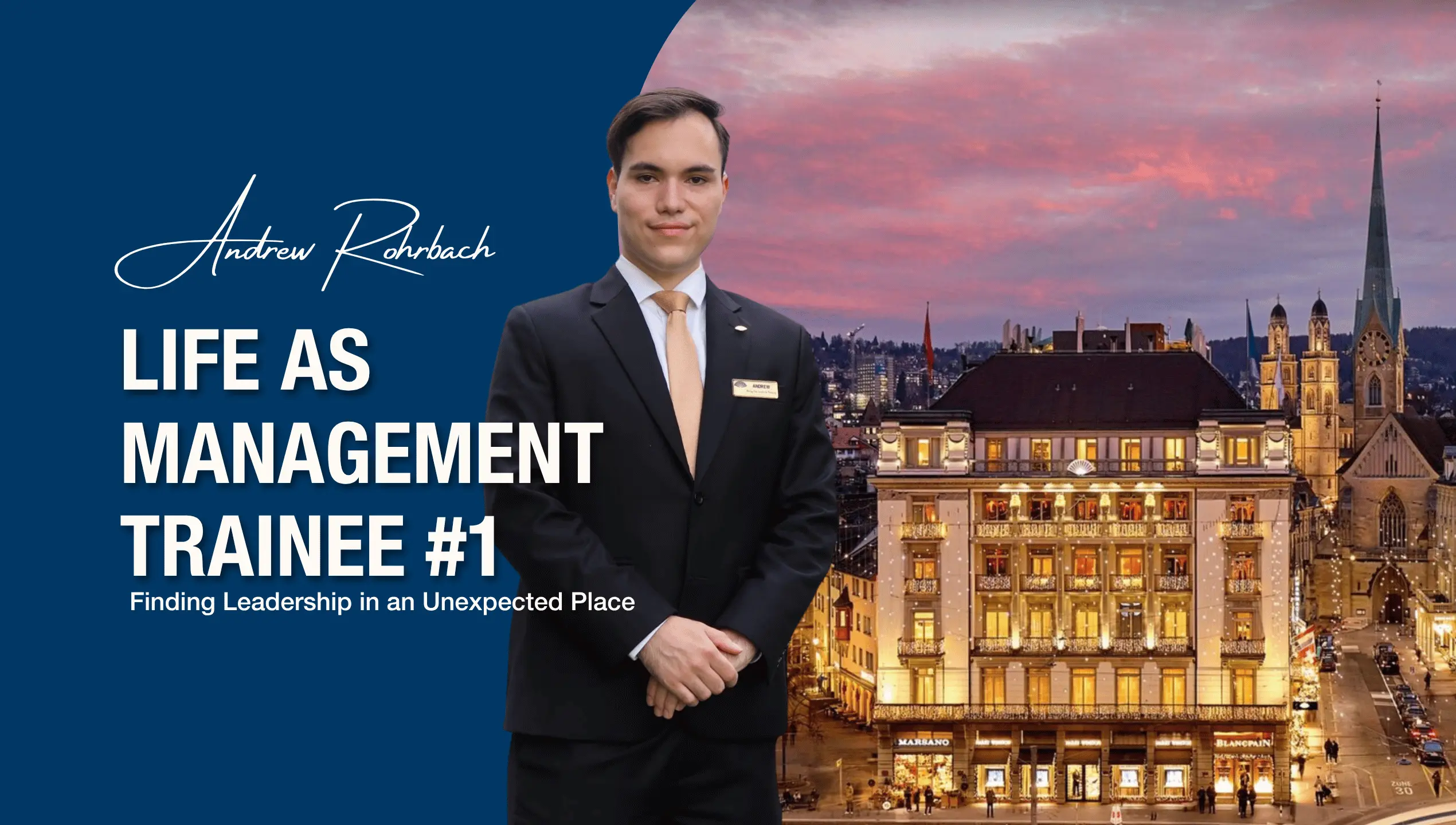
AIHM graduate Andrew Rohrbach did not begin his studies imagining a career in the department that eventually excited him most.
Immediately upon graduation, Andrew, the former President of AIHM’s student government, entered Mandarin Oriental’s Rising Fan leadership development programme. Across both Bangkok and Geneva, he rotated through Front Office, Concierge, Guest Service Centre and Housekeeping departments.

After being recruited by Mandarin Oriental, he found that Housekeeping, a department he had previously overlooked, became the business area that interested him most.
Upon completing his time as a Rising Fan Leader-in-Training, he launched his career with Mandarin Oriental, choosing a strategic role as Housekeeping Supervisor at the Mandarin Oriental Savoy Zürich.
This kind of discovery is part of what internships, rotations and practical experience can provide. You may begin university with one career in mind and then leave with another.
Hospitality management degrees like AIHM’s provide you with with real-world exposure to discover what suits you.
Is Hospitality Management Right for You?
Hospitality management may be worth exploring if you:
- Want a career with international possibilities
- Are interested in business and leadership
- Prefer practical learning alongside academic study
- Enjoy working with people
- Want a degree with several possible career directions
- Are interested in travel, luxury, hotels, restaurants or events
- Can imagine yourself becoming an entrepreneur
- Want skills that can move with you as your career develops
You do not need to have your entire career planned. One of the biggest career advantages of a hospitality management degree is that it gives you so many options and possibilities.
Build a Future With Options: Study Hospitality Management
A hospitality management degree opens doors across roles, industries and countries.
It gives you a business foundation, practical experience and skills you can carry wherever your career develops.
For those who want a degree that can take them anywhere, hospitality management stands as a excellent choice.
Where Could AIHM Take You?
At the Asian Institute of Hospitality Management in Bangkok, students earn a Bachelor of Business Administration in Global Hospitality Management in an international learning environment closely connected to the hospitality industry.
You study at the only campus in the world set within an operating luxury hotel. Over the course of 3.5 years, you network with some of the world’s most accomplished hospitality industry leaders and entrepreneurs.
Enjoy privileged opportunities that can transform your future. Make professional connections in and beyond AIHM that can last a lifetime.
Discover the programme, meet our students and explore where an AIHM degree could take you: