
Sixteen weeks of work. Fifteen minutes to present it.
At the beginning of the semester, the General Manager of Anantara Mai Khao Phuket Villas briefed four AIHM young professionals on a real business challenge. Following a major renovation, the resort wanted a year-round market activation plan for Sea Fire Salt, its signature beachfront restaurant.
Known for exceptional grilled meats and seafood, open-fire theatre and views across the Andaman Sea, Sea Fire Salt was already performing well. Its setting had also recently gained a wider international audience: Anantara Mai Khao played a starring role in The White Lotus Season 3, with the resort appearing in both the serene opening scenes and the season’s explosive finale. The students’ challenge was to build on this strong position, developing a commercial strategy to drive demand throughout the year and stand out in Phuket’s competitive market.
The students studied
The restaurant’s operations and commercial performance, examined internal data, researched Phuket’s tourism markets and developed an activation calendar spanning the high and low seasons. One team member travelled to Phuket to experience the restaurant firsthand. Together, they built an extensive, multifaceted proposal.
Now, in Week 16, they had to distil the comprehesive proposal into a 15-minute video presentation for the General Manager.
Before I started my career in education
I had been working in the hotel industry for many years. Over the years, I found myself having to put forward plans or strategies to owners, developers, general managers and corporate specialists on numerous occasions. Although the situation varies, one rule remains the same: the more senior the audience, the less time you have to make your case.
For the AIHM young professionals, deciding which points were most important and which to leave out was another key lesson in the way industry actually operates.
A Real Brief from a Real Client
The IHP, which stands for the Integrated Hospitality Project, is one of the most important practical learning experiences offered in AIHM’s BBA in Global Hospitality Management.
As they advance through the degree, students carry out three IHPs. Each of these projects combines knowledge from a variety of courses and requires the students to apply that knowledge to a real-world hospitality problem. When they reach their final IHP, the scale of the task is considerable and the students work with a high degree of independence.

For this particular IHP
The third one for the students in question, Anantara Mai Khao Phuket Villas tasked the team with developing a year-round market activation strategy for Sea Fire Salt.
Sea Fire Salt already had:
- An exceptional culinary product
- A distinctive identity
- Elevated service
- A remarkable resort setting
The challenge was to explore those strengths, align them with market opportunities, and build a comprehensive full-year plan.
I began my own career in F&B
Later spent many years leading hotel operations. I naturally look at a restaurant from both sides of the kitchen door. Guests may see the sunset, the fire and the plate arriving at the table. Hospitality professionals must also see the positioning, people, systems and commercial decisions that make the experience possible.
The AIHM team immersed itself in the hard work behind the magic.

The Ingredients: Building the Right Team
As the lecturer coordinating the IHPs, I asked students to volunteer as project leaders and tasked the leaders with selecting their own teams. Zhasmin Zhumabek stepped forward to lead the Sea Fire Salt IHP team and chose three classmates whose abilities complemented one another.
“I chose the team based on their different skill sets, personalities and areas of knowledge,” she explained. Reflecting the international nature of AIHM, each team member also came from a different country:
- Zhasmin, hailing from Kazakhstan, took responsibility for the overall direction of the project, including delegation, deadlines, quality control and risk management.
- Maldivian team member Ahmed Maain Mohamed focused primarily on commercial and marketing strategy, event economics and feasibility.
- Shwe Kaung Kin Cho from Myanmar, who is known as Sky, worked on partnership metrics and became the team’s eyes and ears in Phuket.
- Jatsupa Koysomboon, who goes by Jna and is a team member from Thailand, carried out research and design as well as developing the year-round activation calendar.
Building a strong team was in fact a project management exercise since no single person sees a project in exactly the same way. A solid project team brings those different perspectives and individual talents together.
After thinking about the requirements of the project, Zhasmin chose people who could contribute different strengths.
Beyond the Brief: Project Management Foundations
The project began with a written brief and a 30-minute meeting with the resort’s General Manager. From there, the team had to determine what else they needed to know.
They requested internal materials including brand guidelines, cover data and information about the restaurant’s economics, and also examined Phuket tourism statistics, studied seasonal travel patterns, and considered both resort guests and outside diners.
They also recognised the limits of working entirely from Bangkok.
Sky travelled to Anantara Mai Khao Phuket Villas and experienced Sea Fire Salt during both lunch and dinner. She spoke with members of the management team, observed the restaurant’s operations, toured the kitchen and studied how the setting and service changed throughout the day.
“It’s very different to see something in the documents and then see it in reality,” she said.


The visit
Also brought the project’s luxury-resort setting vividly to life. Sky described the beachfront wine room, the long table, intriguing details such as the small turtle-shaped napkin holders, and the views of sunset over the Andaman Sea. She sent photographs and videos to her teammates, along with updated menus and operational documents they could incorporate into their work.
A brand presentation can tell you how a restaurant wishes to be understood. A site visit shows you how it actually lives: how the tables are arranged, how the atmosphere changes from afternoon to evening and what guests encounter before the first dish arrives.
This real-world focus serves as a major strength of each AIHM student’s journey throughout the entirety of their degree: applied learning, real industry experience and networking with hotel leaders.
Managing Eighteen Weeks of Moving Parts
Even the most amazing ideas will crash and burn if a project isn’t managed effectively.
Over the multi-month project, the team had to coordinate multiple strands of work, including market research, commercial analysis, the Phuket site visit, strategy development and the final client presentation.
“The skill we developed most was project management,” Jna said. “We divided each task according to the person’s strengths. We created a calendar and a Gantt chart of what we should do each month and each week, and we adapted our ideas based on feedback.”
Project management and operations management
Are related, but they are not the same. Operations are continuous: tomorrow the restaurant opens again, guests arrive again and the team must maintain its standards. A project has a defined objective, a timeline, assigned responsibilities and a final deliverable for a client.
Students must learn how to manage both.
A Gantt chart alone does not mean that a project is under control. It becomes useful when the team uses it to understand what depends on what, who is responsible and where a delay could create problems elsewhere. The true learning takes place when plans encounter deadlines, competing priorities and the realities of working as a team.

Anantara Mai Khao’s General Manager Serge Cuypers
Highlighted the professionalism behind the team’s working process:
“What stood out was the depth and discipline the students brought to the assignment. They approached the brief as a professional project: clarifying the challenge, organising a substantial body of research, assigning responsibilities and managing their work through to the final presentation. The process demonstrated real commitment and a strong understanding of what effective project management requires.”
The final strategy was the deliverable. Learning how to manage its development was the larger lesson.
Adjusting the Recipe
In Week 15, the team presented a trial version of its work to me.
My role throughout the semester was not to take charge of the project for them. If I assigned every task, corrected every assumption and made every difficult decision, the students might have produced a cleaner first draft, but they would not have gained experience in project management.
The trial presentation was the moment to test the plan more rigorously before it reached the client.
One important issue was seasonality
During Phuket’s high season, Sea Fire Salt may already be heavily booked. Simply attracting more diners is not necessarily the right objective; it could even make it harder for in-house resort guests to secure a table. In that context, the stronger commercial question was how the restaurant might increase average spend per diner.
Low season presents a different challenge. With fewer international visitors, the emphasis can shift towards attracting local residents, domestic travellers and other outside diners.
In response, the students revised their objectives and improved the plan before the final presentation.
When Theory Meets a Business
The IHP also gave the students the opportunity to combine the knowledge they had acquired throughout their degree studies.
Maain drew particularly strongly on his digital marketing classes, where he had studied campaigns, public relations, storytelling, booking funnels and return on advertising spend.
“Some of this seemed very theoretical in class,” he said, “but now we know how to apply it practically within a real business.”
The team mapped the journey
From an advertising impression to engagement, reservation and seated cover. They explored how referral loops and direct approaches to companies could shorten that journey. They studied which international markets performed strongly during different seasons and considered how Sea Fire Salt might connect with local audiences during quieter periods.
Their proposed activation plan also explored partnerships with travel businesses, marinas, luxury shopping destinations and content creators.
The Big Presentation
By the time the final presentation approached, the team had accumulated far more research than they could possibly share.
“We needed to be quite strict with ourselves and ask: Does this presentation convey the message we want to give the client?” Zhasmin recalled. “If we had excess information, we cut it out and made the presentation clearer and more compact.”
The task required managerial judgement.
Students often want to display the full volume of their work. A client or high-level stakeholder does not need to see every chart, discussion or hour of research. The stakeholder needs to understand the situation, the reasoning and the proposed direction.
The team therefore had to decide what deserved those 15 minutes. Four presenters also had to communicate as one unit, with a clear progression from the business challenge to the proposed response.
Developing Ready-to-Work Graduates
After the final presentation, the semester did not end immediately. Within the two weeks that followed, each student completed an individual reflection examining what they had learned from the project, the team and their own performance.
Reflection papers can serve as a powerful active learning approach for university students. Following an assignment, such as the IHP, they identify what worked, where they struggled and what they would do differently the next time they manage a complex assignment.
I have seen hotels from the kitchen, the executive office, the pre-opening site and the classroom. In every setting, new professionals need time to find their bearings. The purpose of the IHP is to give AIHM students that experience before graduation.
Clients do not always provide perfect briefs
Information must be requested. Responsibilities must be assigned. Deadlines compete. Ideas must withstand operational scrutiny. Feedback can change the direction of the work. Months of research may ultimately need to become a 15-minute recommendation.
In AIHM’s BBA, students experience the realities of professional life and are already learning how to manage them. By the time they begin their first official jobs after graduation, they’ve already passed the find-your-bearings stage and can hit the ground running.
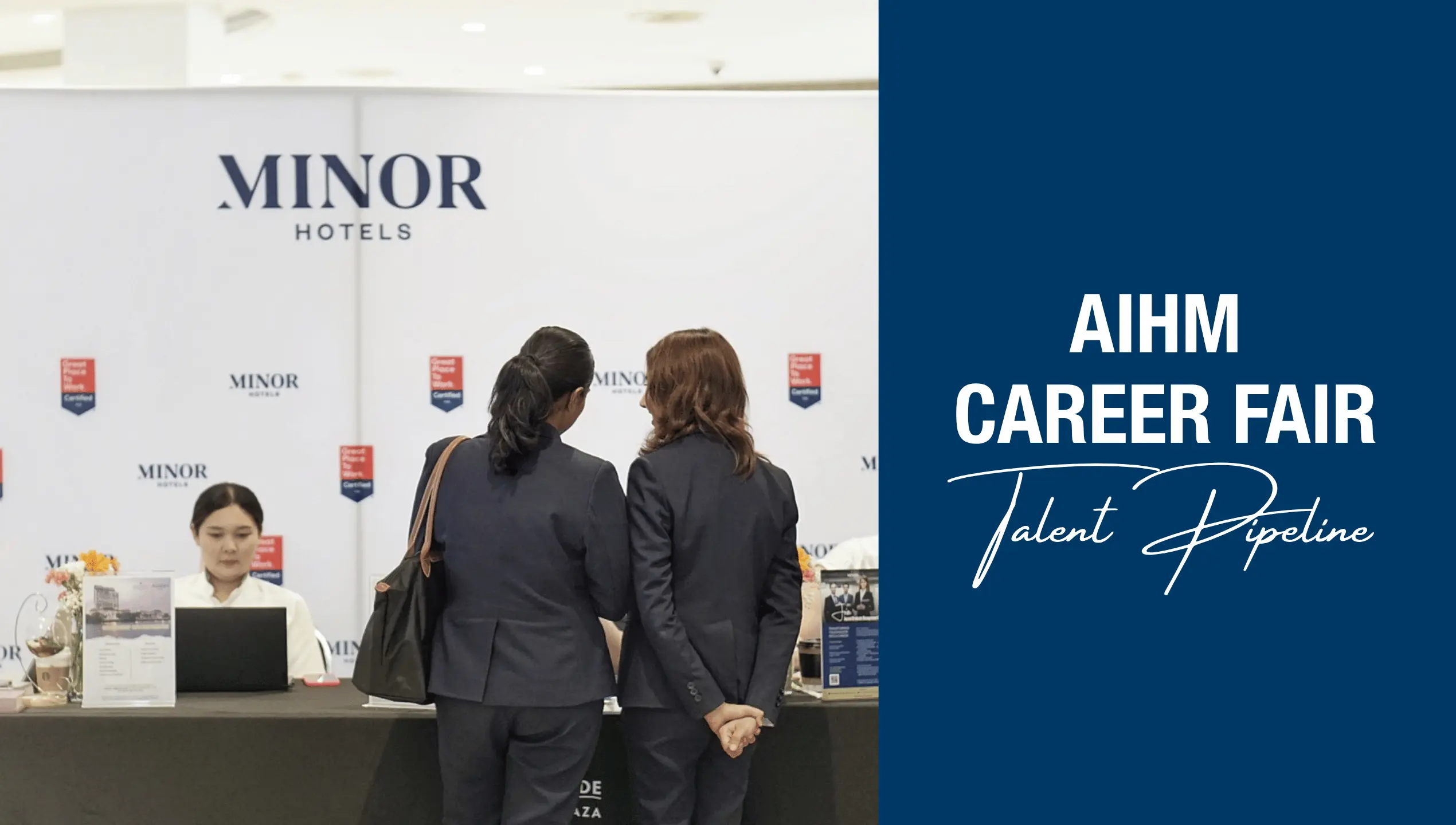
Partner with AIHM to Strengthen Your Talent Pipeline
Are you a hotel or hospitality enterprise seeking to recruit industry-tested, adaptable new talent for your organisation?
Explore recruitment possibilities and our current partners now.